
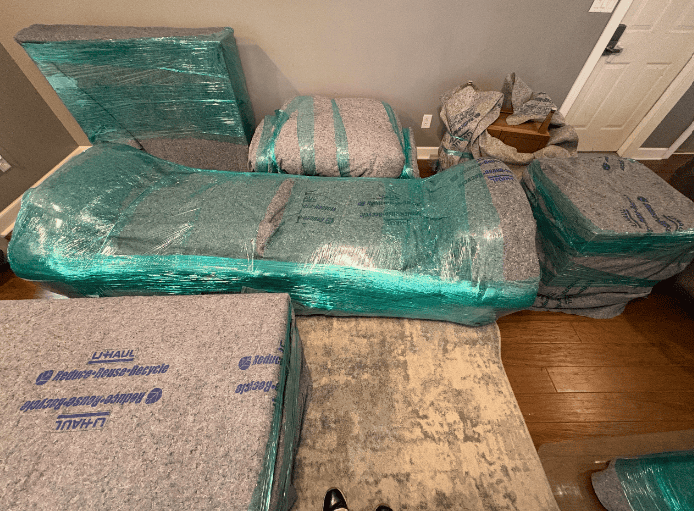
Wrap each piece on its own, cushion it on all six sides, and give the box no room to let anything move. Breakage almost never happens from a single dramatic drop. It happens from an inch of travel repeated over a thousand bumps between here and the new house. We are a locally owned moving company working out of Washington and Bloomington, and the damage our crews get asked about after a self-packed move traces back to the same three causes nearly every time: a box that was too big, a gap that was never filled, and a heavy item riding on top of a light one. None of those need special equipment to fix.
What makes a fragile item break in transit?
Vibration does the work, not impact. A truck bed on a Central Illinois county road transmits a constant low shudder into every box on it, and anything with room to shift will shift for the entire drive. Two wine glasses touching rim to rim will wear through paper and then through each other. A ceramic bowl with an inch of air beneath it will drop that inch a few thousand times.
The next cause is load order, which happens after the packing is done and is entirely outside your control once the truck doors shut. A box marked fragile that ends up beneath a box of books will fail regardless of how carefully it was wrapped. This is why our crews load breakables high and late, and why we ask customers to keep those boxes separate rather than mixed into a general stack in the garage.
Weight distribution inside the box matters just as much. Heavy pieces go on the bottom, lighter and thinner pieces above them, and nothing thin-walled ever carries weight. A box that is correct in every other respect will still lose its top layer if a cast iron pan is sitting on a set of tumblers.
Which materials actually protect breakables?
Plain packing paper does more work than bubble wrap for most household items. It folds tight around an irregular shape, it holds that fold, and it compresses into the gaps around the piece rather than springing back the way bubble wrap does. Bubble wrap earns its place on the things paper cannot handle: framed glass, electronics, lacquered surfaces and anything with a finish that scuffs.
Box quality is where self-packed moves usually go wrong. Grocery store boxes have been stacked, damp and re-stacked already, and their corners have nothing left. Double-walled dish packs cost more and hold their shape under a load, which is the entire point. Here is what a household packing its own breakables should have on hand before starting:
- Double-walled boxes in small and medium only, never large, for anything breakable
- Plain newsprint, more than you think, both for wrapping and for filling gaps
- Bubble wrap reserved for glass fronts, screens and polished finishes
- Heavy tape, run along the center seam and across both bottom edges before filling
- Cardboard sheets cut to size, for laying between layers inside a box
- A thick marker, for the contents and the upright arrow on every side
Old towels, blankets and cloth napkins belong in this list too. They have to travel anyway; they cushion better than most of what you can buy, and using them cuts down on the paper you need.
How should each type of fragile item be wrapped?
The method changes with the shape of the thing. Work through it in this order, and the box builds itself correctly:
- Pad the bottom of the box with three or four inches of crumpled paper before anything goes in.
- Wrap each piece individually, two sheets minimum, folding the ends over the item rather than taping them flat.
- Wrap protruding parts separately before wrapping the whole. Handles, spouts, stems, and lids all snap where they join.
- Stand flat items on edge and lay round items on a bed of padding, heaviest at the bottom.
- Fill every gap with paper or soft goods until you cannot push a finger into the box anywhere.
- Pad the top, close the lid, and lift the box to test. Movement means it goes back open.
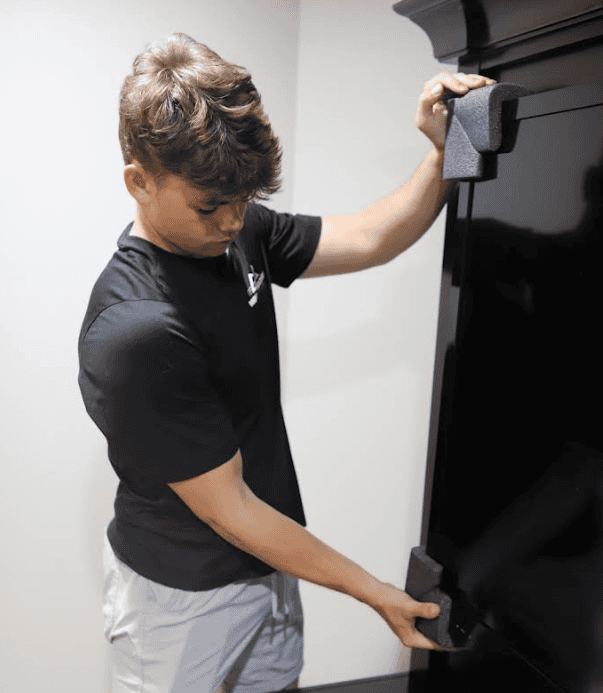
Framed pictures and mirrors need a different approach. Tape a large X across the glass so a crack cannot travel, wrap the frame in bubble wrap, then stand the piece on edge between two mattresses or along a wall of the truck. Flat is the one orientation that reliably breaks glass. Lamps come apart: shade off, bulb out, harp removed, each piece boxed on its own.
High-value and awkward pieces are worth talking about before move day rather than after. Our crews handle grand and upright instruments through our piano moving service, and the same principles carry over to safes, antique cabinets, and anything with a finish that cannot be replaced. Those items get equipment and hands rather than paper.
Not sure whether to pack the breakables yourself or hand them over? Give us a call at (309) 274-0694, and we’ll look at what you own and tell you honestly which pieces are worth handing over.
Does Central Illinois weather change how you pack?
It changes what you do with a box after it is packed, more than how you pack it. Cold makes glass, ceramic, and lacquer brittle, so a box of stemware that sat in an unheated Washington, IL garage overnight in January is more fragile on loading morning than it was the evening before. Keep breakables inside the heated part of the house until the crew is ready for them.
Humidity is the summer version of the same problem. Cardboard that has been sitting in a damp basement or a garage through an Illinois August loses a good share of its stacking strength, and a box that sags is a box that lets its contents move. Damp paper also stays pressed against a finish for the length of the drive. Store packed boxes somewhere dry and off a concrete floor, and pack breakables closer to the move date rather than weeks ahead. The seasonal pattern shows up in other parts of a move too, which is how seasonal weather impacts moving in Central Illinois goes through in more detail.
What should you tell your movers about fragile items?
Name them during the estimate. The walkthrough is when we count what needs dish packs, whether a china cabinet has to be emptied and disassembled, whether a mirror needs a crate, and how much time the fragile work adds. A crew that knows about the glass-front hutch before the truck is loaded plans the load around it, and that plan is worth more than any amount of wrapping.
Point out anything irreplaceable as well, whether that is a piece of art, an heirloom, or a collection. We would rather move it with dedicated handling, or recommend you carry it yourself, than learn its value on the day. Customers who plan their fragile items into the estimate tend to have the smoothest days, and the same holds for the rest of the move, which the ultimate checklist for a stress-free move lays out step by step.
If the breakables are the part keeping you up at night, hand that part over. Call (309) 274-0694 or email us; tell us what you’re worried about, and we’ll build the plan around it.
Related Topics: